|
In June, Jon Hallemeier went to Spokane, WA for initial training as a Conservation Connect Fellow with the National Forest Foundation. In this year-long fellowship, Jon will receive training in facilitation and other skills, engage with academics and professionals working in environmental conflict and collaboration, and help support forest collaboratives working through difficult social and ecological issues.
1 Comment
Jon Hallemeier ventured to Oshkosh, WI for the International Symposium on Society and Resource Management. The symposium brings together people from academics and practice working with the complex social issues involved with natural resource management. The theme of the conference was "Sustainability and the Land Ethic in the Anthropocene: A Thinking Community Explores Critical Issues in Leopold's Backyard." Jon presented research on novel ways to understand the outcomes of collaboration through narratives and networks.
Emily Horton was invited to present at the "Art-science Collaboration for Ecology and Conservation" symposium held at the U.S. International Association for Landscape Ecology (US-IALE) meeting in Fort Collins, Colorado. The symposium was organized by postdocs from the National Socio-Environmental Synthesis Center (SESYNC) and explored current art-science initiatives in conservation and potential future innovations. Emily shared how she employed visual ethnography methods (photography) during fieldwork to answer research questions, inform federal policy discussions, and disseminate findings to study communities via photography exhibits. The inspiring exchange reinforced Emily's desire to continue exploring the art-science interface in her work.
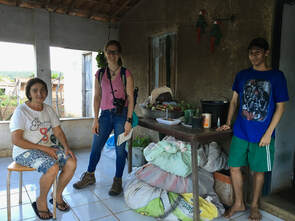 This May in Quixeramobim, Ceará, and as a part of her ongoing collaborative work with FUNCEME, Cydney Seigerman conducted fieldwork with PhD student Hela Guesmi and research fellow Mariana Macahdo Rios, supervised by Dr. Julien Burte (FUNCEME/CIRAD- UMR G-EAU, France). The fieldwork was part of an on-going multi-institution project to assess strategies for sustainable multi-use of small water resources in semi-arid areas. Over two days, the team used GIS methods to assess landscape features, conducted semi-structured interviews, held a focus group, and did participatory mapping with members of a rural community in the region. They also met with the directors of the regional headquarters of COGERH, the State Water Company of Ceará of Quixeramobim.
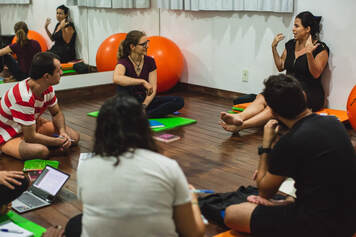 During her May fieldwork in Ceará, Cydney Seigerman participated in a performance arts directing workshop organized by the Escola Porto Iracema das Artes in Fortaleza. The meeting was part of the ongoing work by the study group “Dramaturgia: o que quer e o que pode o corpo” grupo de estudos (Directing: what the body wants and can”), led by Dr. Thereza Rocha, professor of Dance at the Federal University of Ceará (UFC). During the two-hour workshop, Cydney engaged with local directors in discussions that used critical social theory to explore the role of the director in a production.
Cydney Seigerman recently competed as one of ten finalists in the UGA 2019 3MT™ competition held at Athens Cine. In three minutes and with a single, static PowerPoint slide, Cydney explained her dissertation project on water and water insecurity in Ceará, Brazil to members of the broader Athens community. 3MT™ is an international research communication competition, which was developed by The University of Queensland. The competition encourages graduate students to develop their ability to effectively communicate their research to others outside of their chosen field of study.
You can view Cydney’s presentation (starting at about 15:50), in addition to the presentations of the other 2019 finalists here: https://kaltura.uga.edu/media/t/1_gxdlgugm/110536311 Jon Hallemeier and Cydney Seigerman represented HECLab at the 2019 AAG Annual Meeting in Washington DC.
Cydney gave a performance-based presentation on knowledge production and water management in Ceará, Brazil and an analysis of her presentation as part of qualitative research methods using multi-modal analysis and genre theory. Jon presented on the role of collaboration in shaping forested landscapes in the southern Appalachians. Cydney Seigerman recipient of NSF Graduate Research Fellowship and Fulbright Research Grant4/2/2019 Cydney is one of seven graduate students at the University of Georgia to receive a 2019 National Science Foundation Graduate Research Fellowship (NSF GRF). The NSF GRF includes three years of financial support for Cydney’s graduate studies at UGA.
The fellowship program “supports outstanding graduate students in NSF-supported science, technology, engineering, and mathematics disciplines who are pursuing research-based Master's and doctoral degrees at accredited United States institutions” (https://www.nsfgrfp.org/). Cydney was also recently awarded a Fulbright research grant for 2020 to support her dissertation fieldwork in Ceará, Brazil. Collaborating with local communities and state agencies, Cydney will study the lived experience of water insecurity by examining the dynamic interactions between individuals, social and political structures, environmental factors, and technology. For more information on the Fulbright program: https://us.fulbrightonline.org/ Great HECLab representation at the SfAAs! Don Nelson, Emily Horton, John McGreevy, and Jon Hallemeier presented research at the annual meeting of the Society for Applied Anthropology, which was held this year in Portland, Oregon.
Don gave a talk on CZO research describing historical land cover evolution in South Carolina; Emily presented dissertation results exploring underappreciated narratives of artisanal fishing and how narratives shape policy; Jon presented preliminary analysis exploring collaborative politics and competing claims to collaboration in a national forest planning process; and John Ryan presented preliminary dissertation work. |
HECLAB newsLearn about what we have been up to. Archives
February 2024
CategoriEs
All
|
 RSS Feed